Avialsync
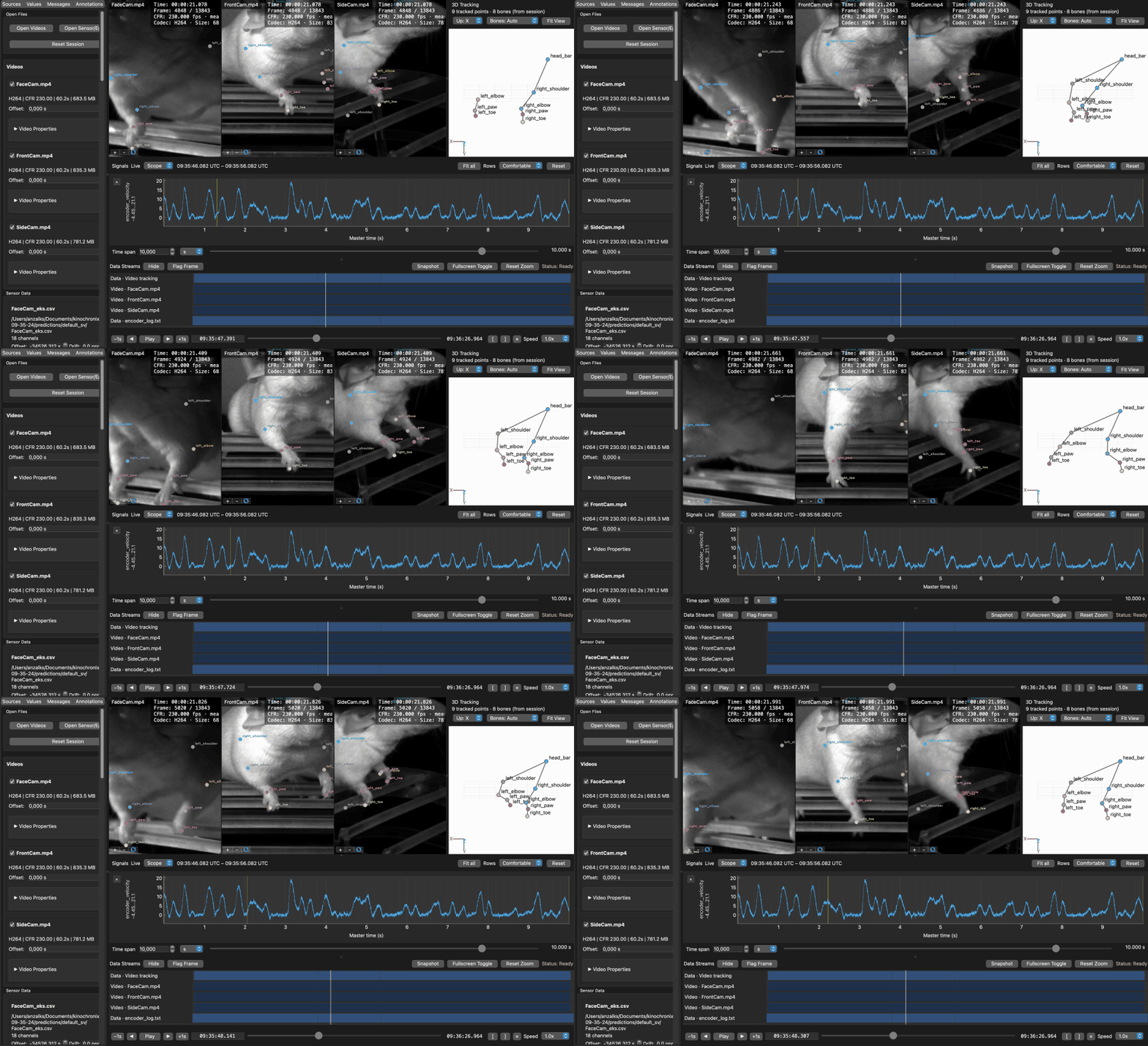
AvialSync is a desktop application for viewing video and time-stamped experiment recordings on one shared timeline. Cameras, TTL and trigger channels, sensor readouts, and electrophysiology traces all play against a single master clock, and if you have tracking data, the pose overlays sit on each camera view with the triangulated 3D reconstruction alongside them. Video decoding is built in, so recordings from most rigs open without installing anything else, and a file with an unusual extension is read on its contents rather than turned away on its name. Electrophysiology files from common acquisition systems load directly, and sensor and tracking tables come in through a guided importer where you set the time column, units, and timestamp handling. Scrub to any moment, and you see what every stream was doing at once. Recordings can be aligned by hand with a fixed offset, or worked out from the trigger signals themselves, and each frame’s real timestamp is read rather than the frame rate the file claims, which keeps things accurate when a camera runs on a variable trigger. Marking a frame records the exact frame number in every camera loaded, so what you export tells a pose model like DeepLabCut or LightningPose precisely which frames to correct. Anything lab-specific can be added as a plugin without touching the core application.
GitHub Documentation
SynaptiPy

SynaptiPy is a desktop application for visualising and analysing electrophysiology recordings. It supports files from most common recording hardware, so you can load your data regardless of which acquisition system you use. The GUI lets you run standard analyses like spike detection, input resistance, membrane time constant, and synaptic event detection interactively, and if you need something custom, you can write your own analysis as a plugin, and it plugs straight into the same interface. You can run analyses across large batches of files and export results to CSV or NWB, keeping your data in formats that meet open data-sharing standards for neuroscience.
🔗 GitHub Documentation
Loctran

Loctran is a local document translator that works on PDFs and images without sending anything to an external server. It uses AI running on your own machine to read and translate content, handles both typed and scanned documents, and gives you back the translated output with text positioned over the original layout. It also lets you compress and convert files, which is handy when you need to get documents under a size limit for uploads. You can use it from a browser interface or the command line, and everything stays on your machine.
🔗 GitHub
Cerebellar Nuclei Connectivity Atlas

The Cerebellar Nuclei Connectivity Atlas is an interactive web-based tool for visualising the complex neural circuitry of the mouse cerebellum. It maps out afferent and efferent projections, allowing you to clearly see excitatory inputs from sources like mossy and climbing fibers alongside the main inhibitory inputs from Purkinje cells. The interface features interactive filters and real-time flow animations, so you can isolate specific pathways, track signal direction, or focus entirely on individual regions like the dentate, interposed, or fastigial nuclei. It runs entirely in the browser, providing a quick, dynamic reference point for exploring the spatial organization of cerebellar networks without needing to parse through dense literature.